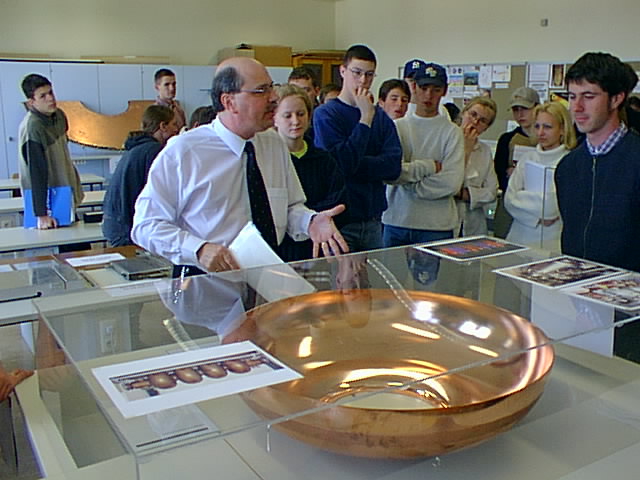
| Prof. Schoeberl explains a part of an accelerator from CERN. |
 |
In an exhibition in the physics lab, parts of detectors for elementary particles were presented that belong to the world-famous research institute CERN near Geneva. How did this happen?
In our physics class, the pupils of the 7c and myself wanted
to get more detailed information about the installations that accelerate
elementary particles to the speed of light and then let them collide.
We began to surf in the Internet and soon found something: the homepages
of the research institutes at the CERN near Geneva and of the DESY in
Hamburg provided us with interesting photographs and many new information.
Then we had the idea to visit one of these impressive sites. In order
to collect more information for our planned excursion, I did some more
surfing in the Internet and fished the e-mail-address of Professor Dr.
Franz Schoebel out of the net. This gentleman offered immediately to help
us preparing our trip (he himself also does this excursion every year
with his students at Vienna University). Furthermore, he offered to present
an exhibition and give a lecture at the BG Schwechat as a preparation
for this excursion.
This exhibition was prepared in cooperation between the
Institutes for High Energy Physics and for Theoretical Physics and Vienna
University. Exhibited were parts of giant detectors built in Vienna, and
photographic and graphic material from the research centers in Geneva
and Hamburg. In addition, a film and a multi-media CD on elementary particles
were presented.
The lecture by Professor Franz Schoeberl with a short guided
tour through the exhibit took place on May 5, 1998, and was attended by
physics teachers and the pupils of the 6th and 7th
grades. I believe that Professor Schoeberl managed to enthuse not only
the teachers but also the pupils with his lively talk.
The 7c and myself now hope that to complete our project,
the planned excursion to Geneva will really take place next autumn!
We learnt how the labs in Geneva manage to prove the existence
of the smallest particles, the quarks, and we were surprised about the
incredible efforts necessary to do so: in depths of 100m, an accelerator
ring was built which is 27km long and contains gigantic, extremely heavy
detectors, in which the particles are accelerated to the speed of light
and then are made to collide. The small fragments resulting from that
do not only provide information about the structure of matter but also
about what might have happened at the big bang. And who knows of what
use may be the results of this basic research for mankind in the decades
to come?
He himself works at CERN and organizes excursions with his
students to Geneva.
| << Previous Page |
|
