Istituto Tecnico Industriale Statale "Oreste Del Prete"
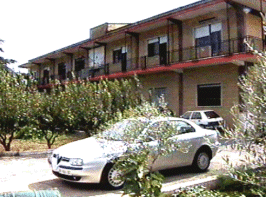 "Oreste
Del Prete" High School lies in an agricultural community setting in the
South of Italy, Sava.
"Oreste
Del Prete" High School lies in an agricultural community setting in the
South of Italy, Sava. The school, at present attended by 600 students, first opened its doors to them in 1972. Computer Science is one of the main issues of "Oreste Del Prete", which is both a technical school ("Istituto Tecnico Industriale Statale") and a "liceo" (scientific-technological). As a technical school, it enables students to specialize either in Information Technology or in Electronics and Telecommunications, so giving them the possibility of obtaining a professional qualification.
In both courses students are also required to study less technical subjects which provide opportunities for them to develop their knowledge in other cultural fields and to become critically thinking individuals. The result is that students are also helped with university and their future career.
As a "liceo", the school provides a still broader education aiming at finding a link between science and technology, humanistic culture and scientific issues. The curriculum, in fact, includes subjects such as Italian (language, literature and history), English (ESP and English Literature), Philosophy, Mathematics, Physics, Geography, Chemistry, Biology, IT. The general goals of the school include: the development of intellectual ability; social and cultural understanding; personal achievement and fulfillment; the development of students' awareness of the wider aspects of living in society; the reinforcement of students' responsiveness to the needs not only of self but of others.

 The school attempts to foster these objectives by providing some specific
co-curricular, non-academic activities,which also enhance students' motivation
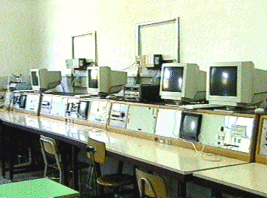
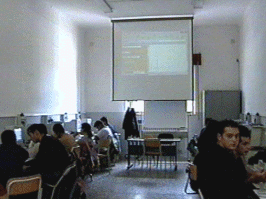
to succeed at school. "Oreste Del Prete" school is supplied with many
modern labs whose computers and technological equipment allow students
to practice what they study at school and to live each learning experience
"from
The school attempts to foster these objectives by providing some specific
co-curricular, non-academic activities,which also enhance students' motivation
to succeed at school. "Oreste Del Prete" school is supplied with many
modern labs whose computers and technological equipment allow students
to practice what they study at school and to live each learning experience
"from
Scientists in Desy in Hamburg
On the second day the pupils formed small groups and accompanied scientists who worked there to their experiments. So they could get a good impression of the working methods of a scientist. Here you can see some small reports about the impressions of the pupils of this „Research Live„ :
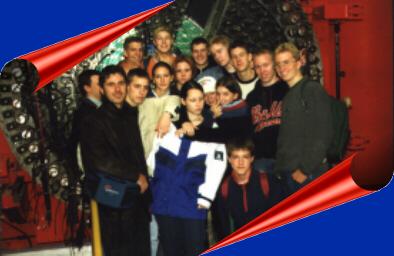
A scientist in DESY by Chrisi, Evelyne, Susi, Maria.On the second day we split up in groups of four to watch different researchers. Our scientist - unfortunately we don ΄t know his name - welcomed us in a very friendly way and immediately told us of a problem they have with mice in his office. This seemed to be his biggest duty at the moment.It didn΄t look as if he were dying of stress. This phenomenon you can find very often among the researchers in DESY. When they are taking measurements for a week, they work day and night. When they are over, they have hardly anything to do for months.
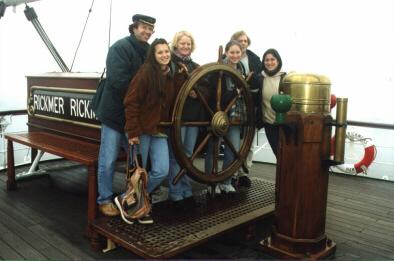 Our leader led
us to his special project, but we only saw many computer screens and a room
which nobody could enter. Next he showed us his office in which there was
a creative untidiness. The walls were full of cartoons which he explained
to us with visible pleasure. After that he described his current project
to us by using a very picturesque way of presentation. Amongst others he
tried to make us understand it with the principle of playing pools. His
experiment, however, is named INELAX. At the end of the presentation our
scientist ate lunch with us. While eating good food and sitting in the sun
we learned much of him again. But this time it was about going out in Hamburg
in the evening. All in all it was very funny and also interesting in a physical
way.
Our leader led
us to his special project, but we only saw many computer screens and a room
which nobody could enter. Next he showed us his office in which there was
a creative untidiness. The walls were full of cartoons which he explained
to us with visible pleasure. After that he described his current project
to us by using a very picturesque way of presentation. Amongst others he
tried to make us understand it with the principle of playing pools. His
experiment, however, is named INELAX. At the end of the presentation our
scientist ate lunch with us. While eating good food and sitting in the sun
we learned much of him again. But this time it was about going out in Hamburg
in the evening. All in all it was very funny and also interesting in a physical
way.

A theoretical physicist at DESY
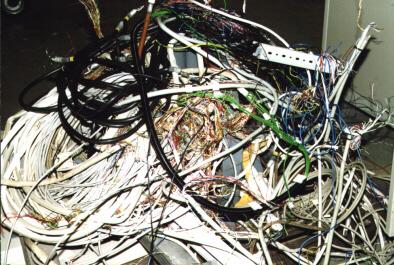 particles charged, which are often proved weeks or months later by detectors.
Later on they try to form the formula describing the newly found particle.
This requires a special programming of the computer, which takes about a
half year to be finished. Then you are able to enter the information into
the computer. Now it is possible to say, if it is a new particle or an old
one. Because the content of the work of our physicist is very difficult
to understand, we are not able to give a more detailed description, although
he tried to explain it to us. We hope to have given you some insight into
the work of physicists of DESY with these short report.
particles charged, which are often proved weeks or months later by detectors.
Later on they try to form the formula describing the newly found particle.
This requires a special programming of the computer, which takes about a
half year to be finished. Then you are able to enter the information into
the computer. Now it is possible to say, if it is a new particle or an old
one. Because the content of the work of our physicist is very difficult
to understand, we are not able to give a more detailed description, although
he tried to explain it to us. We hope to have given you some insight into
the work of physicists of DESY with these short report.
Community College Bishop’s Castle
Catchment Area & Sphere of Influence
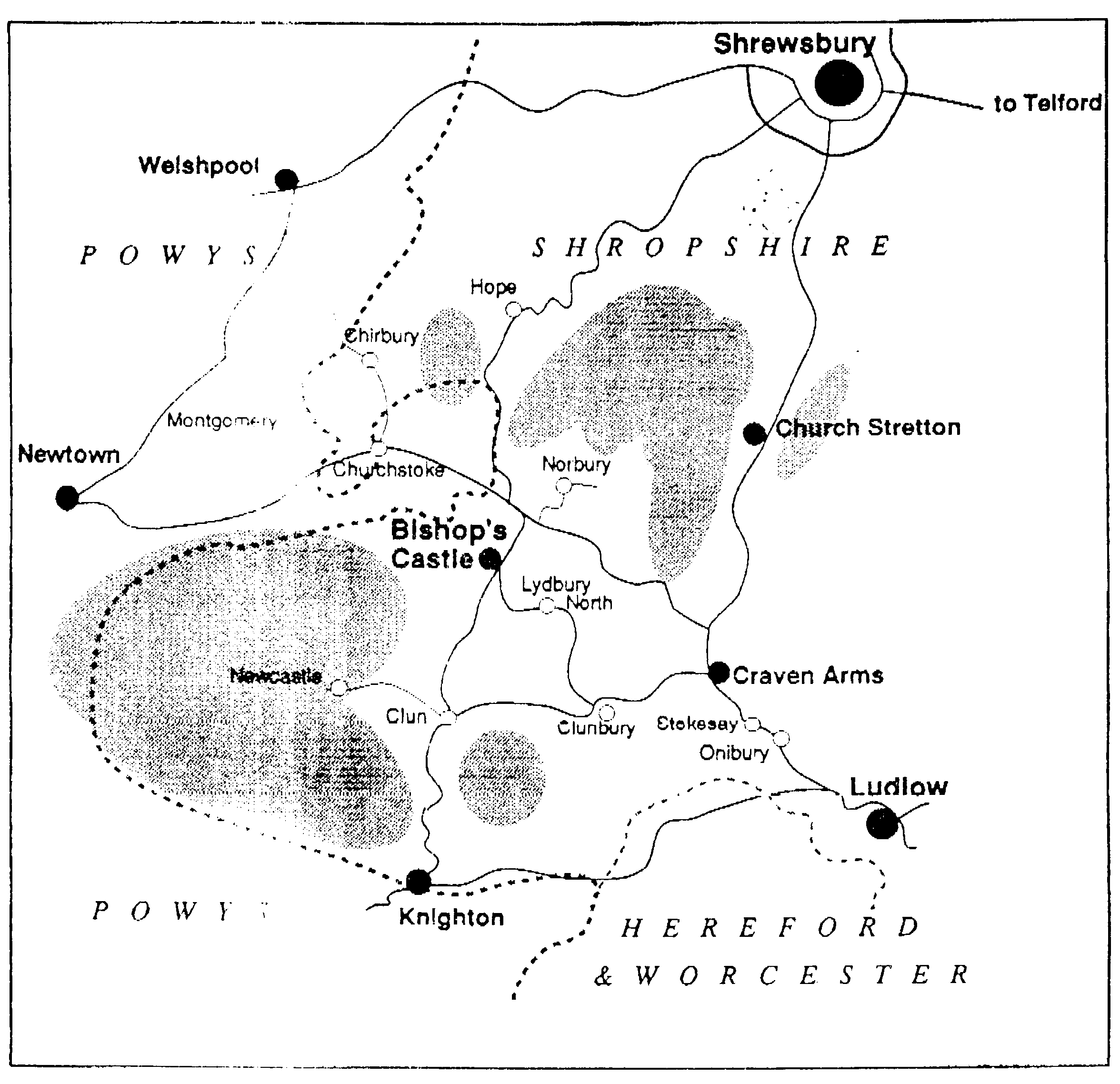
A substantial building project to replace the "Old School" and the Horsa huts began in October 1985. The two new blocks provide a library, a resources room and teaching rooms for English, Art, Information, Technology, Home Economics-Textiles, Food and Nutrition and Child Care, a medical room and a Heads of School Office. Considerable reorganisation of other accommodation hs followed. The last phase of building has seen the final demolition of the 1949 Horsa huts and the building of two new science laboratories. Additional "demountables" have given us new History and Geography siutes, extra English and Special Needs rooms. The school house has been adapted to make a new Post-16 Centre and a new Community building has been added. The school's reorganistion as a full 11-18 mixed comprehensive school took place over a number of years. In 1950, it became bilateral, and in 1964, after the abolition of the 11+ examination, it was deemed to be fully comprehensive taking all children from a large area of south-west Shropshire.
In the Spring of 1985, the County's Falling Rolls Working Party visited the school, subsequently confirming its future as at least an 11-16 school. In December 1985 their report, "Towards 2000" proposed the removal of our Sixth Form. A number of working parties, representing governors, staff, parents, pupils and members of the local communities, met to discuss the proposals "Beyond 2000", emphasising the need for Post-16 education in Bishop's Castle. The result was the Community College Project. This was made permanent in 1987 and in 1991 the County High School and Community College combined under the name The Community College. 1997 is a Year of Celebration. Namely, 75 years have passed since the founding of "The County High School" and 10 years as a designated Community College.

| << Previous Page |
|
