
 |
Dear Partners, With the 5th issue of ESEM (European Students Environmental Magazine) we are entering in the second year of e-HERMES project. 14 schools from 13 countries of Europe are participating in the common effort. Interesting quantities, related to the quality of life in modern society, such as electro-smog, UV radiation and noise are being measured after the purchase of more sophisticated and suitable equipment. The first Partnership's meeting took place in Athens last September. Useful conclusions and new ideas were presented in order to increase the involvement of the students at the second phase of the final run. The solutions implemented so far make best use of existing technologies (flexible internet programs, mailing list, bulletin board with the question of the month and databases). Students collect data, form hypothesis, perform statistical analysis and finally present and publish their results. |
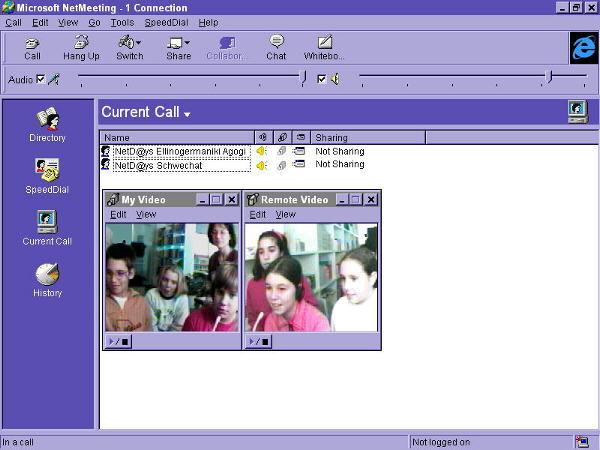 |
Now a new idea is entering in
order to fulfil the student's request. Video conferencing has been
successfully tested the last two weeks -also during the presentation
of e-HERMES project at the program NETDAYS EUROPE 98, which took place
last October in Athens- and now is applied as a strong communication
tool in the small scientific society of e-HERMES. Students will have
the chance to communicate in weekly basis and discuss on-line with
their virtual classmates. |
| Since September 20th
we are measuring temperature, rain, energy, air pressure, humidity
.... again, we have started the e-Hermes-Project again! With our Maths-teacher,Dr.
Eisenbarth, we went into the school garden to the place, where the
instruments are located in the measurement station. After holidays
we had put the instruments in it and then we begun the new measuring-year.
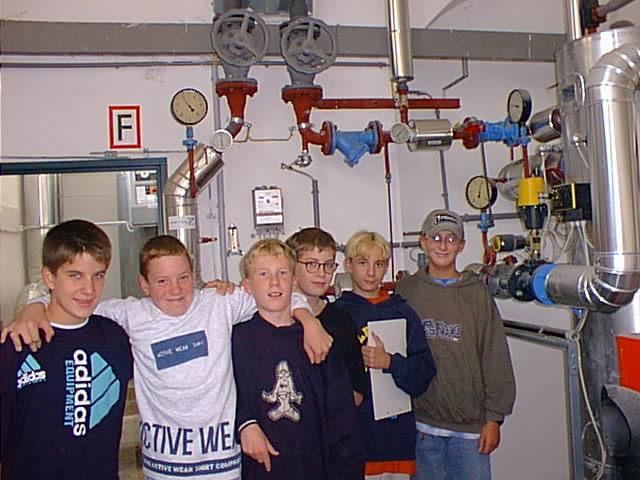
Once a week we go to the basement of our school, where we can read
the energy consumption (electric and Fernwaerme). We also have made
some pictures with our digital-camera and we hope to see these photos
in the next ESEM. We write all measuring data in a table and then
we put them in the computer and send them to Athens by INTERNET. We
all are very interested in which way pupils in Athens read data and
put them in the computer. We are very happy to participate in this
interesting project e-Hermes. At the end some words about ESEM: we
hope to see the fifth ESEM very soon. Since we take part in e-Hermes
we spend more time in the computer room. We like this because we also
are allowed to search the web! We hope many pupils will read our letter
und wish you much fun in working on the project. Yours sincerely Eni, Robert and Christoph |
 |
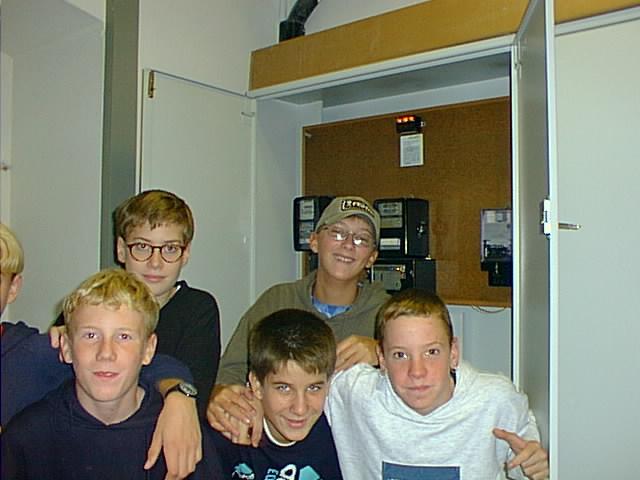 |
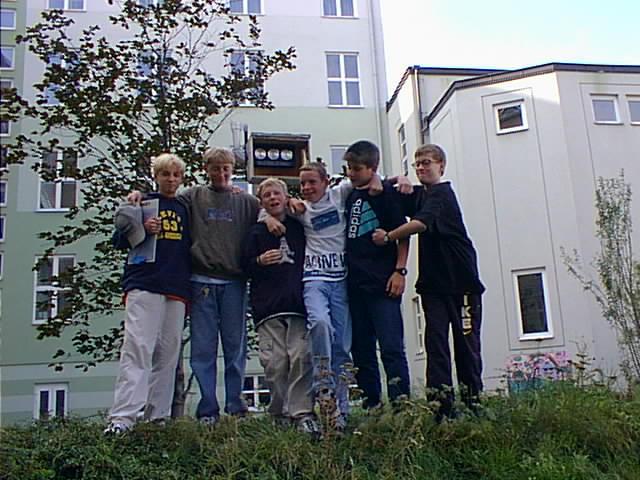
On Saturday the 19th September we (Thallili, Seemi, Arno, Markus, Sanja and Robert) went to our meteorological station in our school garden with our mathematics teacher Dr. Eisenbarth. After the summer holidays we put all the ganges into the station. We also took some photos and we hope they will be published in the new Esem magazine. Then we began with the measurements. With our equipment we canmeasure the relative humidity and the amount of precipitation. We note all these dates into a list and in a free hour we enter the data in the e-tool form on PC. Our physics teacher Prof. Ehrentraut helps us when we have any questions or problems. |
| Once
a week we also note the energy data. This we only can
with our mathematics teacher, because we aren't allowed to enter the
rooms of the technical equipment. All of us are very interested how
the school from Greece handles the measurements. And now to the 4th
Esem magazine: I hope that the 5th issue will be published soon. We're
very happy to take part in this project, because we often go to the
EDV-room. We visit many pages in the internet (weather, satellite,
and so on) and when we have any questions or problems. Once a week
we also note the energy data. This we only can with our mathematics
teacher, because we aren't allowed to enter the rooms of the technical
equipment. All of us are very interested how the school from Greece
handles the measurements. And now to the 4th Esem magazine: I hope
that the 5th issue will be published soon. We're very happy to take
part in this project, because we often go to the EDV-room. We visit
many pages in the internet (weather, satellite, and so on) and when
we have solved our tashs, we can surf in the internet, which is very
interesting. We hope you have read our letter and we wish you very
much fun with the project. By Marion, Sanja, Thien and Thallili |
 |
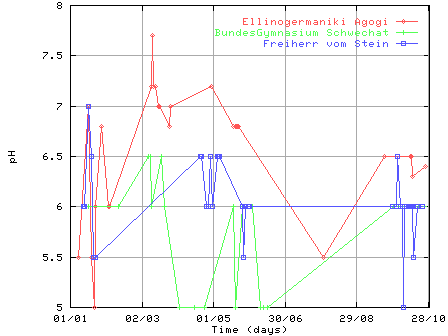
Comparing the 3 diagrams we observe that the pH
of the water of the Austrian and the German school is lower than Ellinogermaniki
Agogi (For the German school we do not have enough information to justify
it). So we wondered why is this happening, in other words why there is
a big difference in the pH between Ellinogermaniki Agogi and Schwechat
and we concluded that if we want to end somewhere we must ask the Schwechat
students if their school is near a factory or not. (click on the diagramm
for a bigger size)
The question, which has been made in the videoconference, was answered by the Austrian students. They answered that they are close to a factory and that's why they have these pH measurements. In reverse Ellinogermaniki Agogi is not near a factory and it is also far away from Athens center and this is the reason for the neutral pH.
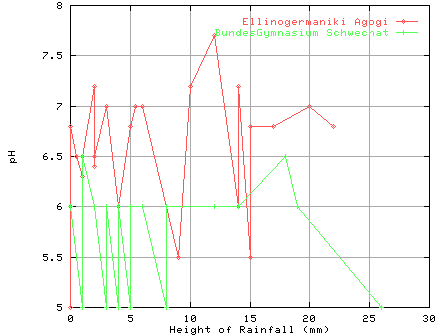
Another item that we must add is that from the observation of the Diagram
height of rainfall pH we can see that neither the frequency nor the quantity
of the rainfall affects the pH of the rain. Making this comparison we
considered some factors tidally such as if the factory which is near Schwechat
was open during the rainfall. (click on the diagramm for a bigger size)
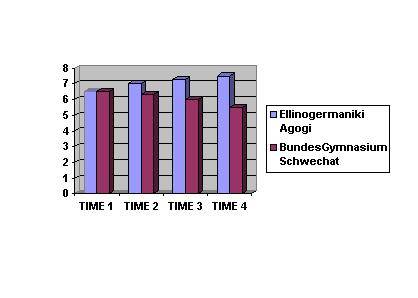
In the above diagram we can observe that rain in the Austrian school is
acidic. So we decided to place a question upon this matter in the Internet.
This was to compare the pH values and explain the differences in these.
In this way, using the measurements, we saw that in the Austrian school
it hadn't rained for a long time so the measurements were acidic. Nevertheless
we found out that in our school it hadn't rained for a long time as well,
yet the rain was not so acidic. So in a videoconference that took place
on Thursday October 22nd 1998 with the Austrian school, we asked them
if there was any factory near their school. The answer was positive and
that explained the measurements. The diagram in four time intervals is
as follows: (click on the diagramm for a bigger size)

Funny weather in Frankfurt and Athens?

|
|
