The Science Day focuses on the research conducted in the Faculty of Behavioural Sciences: national and international research projects and research conducted by individual researchers and doctoral students. Most important event is also the presentations of accepted doctoral thesis of the year 2008. Science days is a forum for scientific discussion, networking and interaction among scholars.
The event is oriented for researchers, doctoral students, and interested scholars and also for the public.
Event's official website:
http://www.helsinki.fi/behav/tiedepaiva/2009/index_english.htm
Abstract to Science Day 17th of May 2010 University of Helsinki
Visualising the Invisible: science learning via Augmented Reality (AR) technology application
The study presents an implementation of Augmented Reality (AR) technology in science education. While this technology up to now mainly was used by the military and high-tech companies it gradually converts into wider educational use. Specific research programmes such as CONNECT and EXPLOAR tested and applied this technology especially with regard to selected learning scenarios by a close co-operation of formal education and informal learning. Empirical effects related to intrinsic motivation and cognitive learning of students (n:308) were encouraging. The implementation of Augmented Reality in the context of the Hot Air Balloon exhibit unveiled encouraging results: While the high achiever again did best in the post-knowledge test, low achiever again were clearly catching up with the others. The difference to between test group and the control group was clear. It seems like that visualising very theoretical scientific phenomenon increased the understanding
substantially for students who otherwise had severe difficulties. This is an essential result which needs further analysis. The “new educational model & paradigms” was monitored for 182 teachers. The main focus, however, pointed to a feed-back of in-service teachers and teacher students since they act as key players in the use and acceptance of any new educational technology or curriculum renewal. The main objectives were as follows: (i) From a teacher-controlled learning towards a pupil-orientated learning; (ii) connecting of ICT-AR with and between existing learning environments; and,(iii) changes in roles and responsibilities of students and teachers. These results have lead into process of creating a new portable small scale set science learning teaching equipments (Science Center to go) in the classroom and open learning environments.
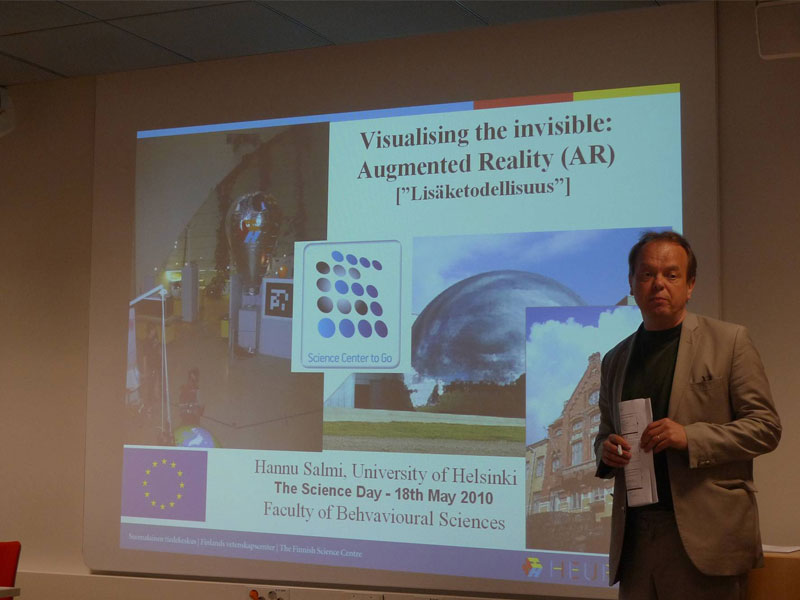
Hannu Salmi presents Augmented Reality in Science Day at the University of Helsinki 17th of May 2010.